
Lift station odour control becomes a top priority when hydrogen sulphide (H₂S) and other sewer gases begin to create problems beyond the wet well itself.
Complaints from nearby residents, corrosion within the infrastructure, and safety concerns for operators often trace back to the same issue: untreated foul air accumulating within the lift station.
Unlike larger wastewater treatment facilities, lift stations present a unique set of challenges. They are frequently located near residential developments, operate within confined footprints, and experience highly variable flow conditions throughout the day and year.
Because of this, eliminating odours at the source is often the most reliable way to prevent these issues from escalating into maintenance, compliance, and community-relations problems.
Why Lift Stations Create Persistent Odour Problems
A lift station is designed to collect and pump wastewater from lower elevations to higher points within the collection system. During that process, wastewater often remains stagnant for extended periods, particularly in force mains, wet wells, and low-flow sections of the system.
As oxygen levels decline, anaerobic bacteria begin breaking down organic matter. One of the primary byproducts is hydrogen sulphide gas. The longer wastewater remains under these conditions, the greater the opportunity for H₂S concentrations to increase.
There are a few factors that make lift stations particularly vulnerable to odour generation, including:
- Long retention times within wet wells and force mains.
- Warm temperatures that accelerate biological activity.
- Variable flows that create periods of stagnation.
- Limited ventilation within enclosed structures.
- Proximity to residential or commercial development.
Unlike treatment plants, which often have multiple stages of odour management built into the facility, many lift stations were not originally designed with dedicated odour-treatment infrastructure.
H₂S Creates More Than Just Odour Issues
Most people associate hydrogen sulphide with the smell of rotten eggs. While troubling, the odour is usually just the first sign that conditions are deteriorating inside a lift station. The gas creates operational concerns long before those concentrations become hazardous.
Corrosion is often the most expensive consequence. When H₂S combines with moisture inside pipes, valve chambers, and concrete structures, it can form sulphuric acid. Over time, that acid attacks concrete, coatings, metal components, and electrical infrastructure. Municipalities can spend significant amounts repairing damage caused by long-term corrosion in wastewater assets.
Odours create another challenge: public perception. Residents don’t typically distinguish between nuisance odours and safety risks, so if sewer gas becomes noticeable outside the property boundary, complaints often follow. Repeated complaints can increase pressure on public works departments to implement permanent corrective measures.
Operator exposure is the final yet equally important consideration. While odour complaints may drive the initial discussion, worker safety remains an important part of lift station design and operation whenever H₂S is present.
Why Traditional Lift Station Odour Control Methods Often Struggle
All too often, municipalities begin with temporary or passive approaches to odour management. Carbon filtration, for instance, is a common option. Activated carbon can perform well when contaminant loads are relatively low and predictable, but lift stations seldom operate under perfectly consistent conditions.
Storm events, seasonal temperature changes, industrial discharges, and population growth can all increase contaminant loading, and as loading increases, carbon media often requires more frequent replacement.
These facilities commonly encounter challenges such as:
- Shorter-than-expected media life.
- Breakthrough odours between changeouts.
- Increased replacement costs.
- Reduced performance during humid conditions.
- More frequent maintenance requirements.
Chemical scrubbers can provide effective treatment, particularly when H₂S concentrations are elevated. However, they introduce additional operational requirements, including chemical storage, requiring targeting specific constituents, dosing equipment, delivery schedules, and safety procedures. For smaller municipal sites, that added complexity may not be desirable.
Biofilters are another proven technology, but they typically require a larger physical footprint than many lift station sites can accommodate.
Space Constraints Change the Equation
Site limitations often become one of the primary factors influencing technology selection. Lift stations rarely have excess space available for large treatment systems.
Many were built decades ago and now sit within developed urban areas where expansion opportunities are limited, if they exist at all. Adding chemical storage tanks, large media beds, or additional treatment buildings is not practical.
Compact treatment systems can provide a significant advantage, allowing facilities to improve odour control without major site modifications or extensive construction. This is particularly relevant and valuable for retrofit projects where existing infrastructure must remain operational throughout installation.
Why Photoionization Works Well for Lift Station Odour Control
Space limitations, variable odour loads, and the maintenance demands of traditional treatment methods often narrow the list of practical solutions for lift stations. Photoionization technology is frequently selected because it addresses several of these challenges at once.
Rather than storing contaminants in media or relying on chemical reactions within large treatment vessels, photoionization systems treat odorous compounds as contaminated air moves through the unit at negative pressure to ensure no foul air can escape.
This approach offers several advantages for lift stations:
- Compact equipment footprints suitable for constrained sites.
- Consistent treatment across fluctuating odour loads.
- Minimal routine maintenance requirements.
- No chemical storage or handling requirements.
- Continuous operation without frequent media replacement.
A Lift Station Example: Cerro Colorado
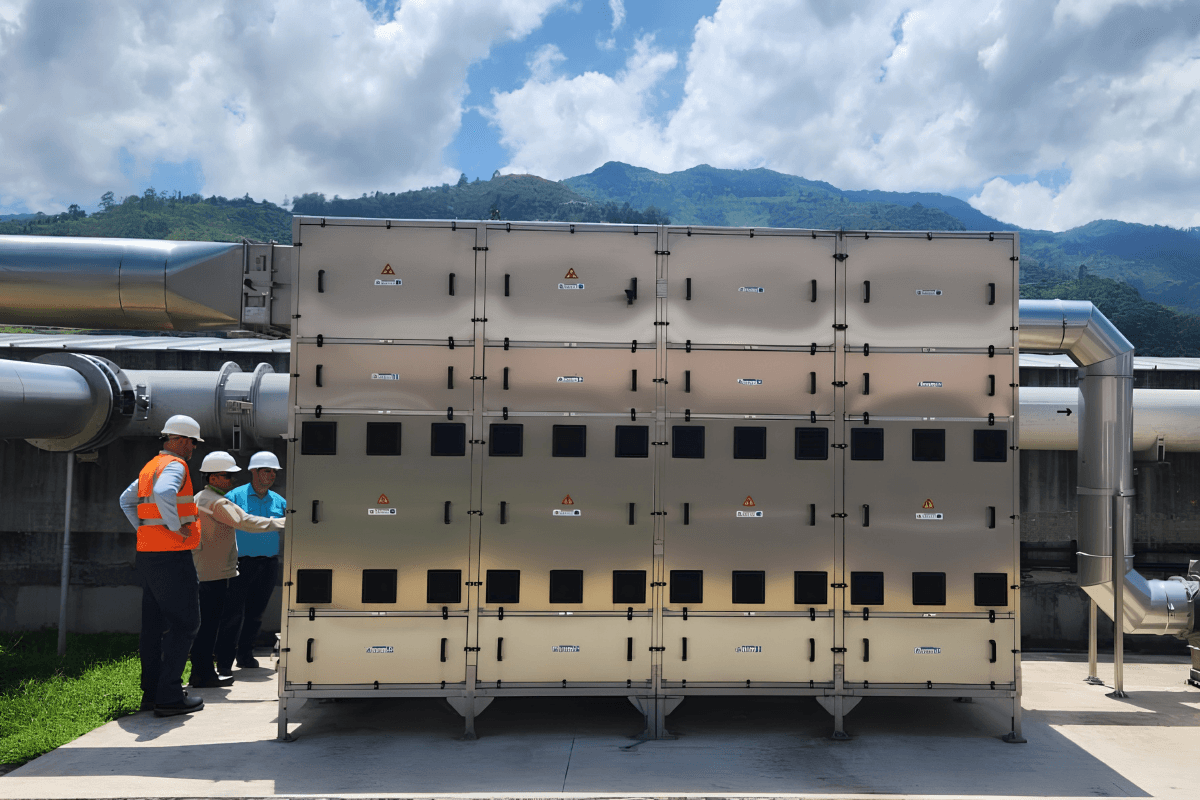
The Cerro Colorado Lift Station in Guayaquil, Ecuador, highlights several of the conditions that can make lift station odour control particularly challenging. Humidity, contaminant loading, future capacity requirements, and available space can all influence technology selection as much as treatment performance itself.
This site in particular experiences tropical weather, high relative humidity, elevated average H₂S concentrations, and significant H₂S peaks.
A biofilter was initially considered for the project, but the operating conditions and fluctuating sulphide levels pointed toward a different approach. NeutraTek installed a dual-phase Neutralox photoionization system designed to accommodate changing airflow requirements as the lift station’s influent volumes increase over time.
The system was selected for its ability to deliver high H₂S removal performance without the large footprint, media management, or ongoing maintenance requirements associated with some conventional treatment technologies.
Looking Beyond Temporary Odour Management
Lift station odour issues rarely resolve on their own. As infrastructure ages and surrounding development increases, nuisance odours often become more noticeable, not less.
And at a certain point, managing odours becomes a necessary, often cumbersome, part of daily operations. Facilities that find themselves replacing carbon more frequently, responding to recurring complaints, or dealing with ongoing corrosion may benefit from evaluating permanent treatment options designed specifically for wastewater environments.
Lift station odour control is most effective when contaminants are treated before they leave the source. A properly designed system helps protect infrastructure, reduce nuisance odours, and support more consistent operation of the collection system over the long term.
Contact us today to learn more about how NeutraTek’s Neutralox photoionization system addresses lift station odour challenges.