
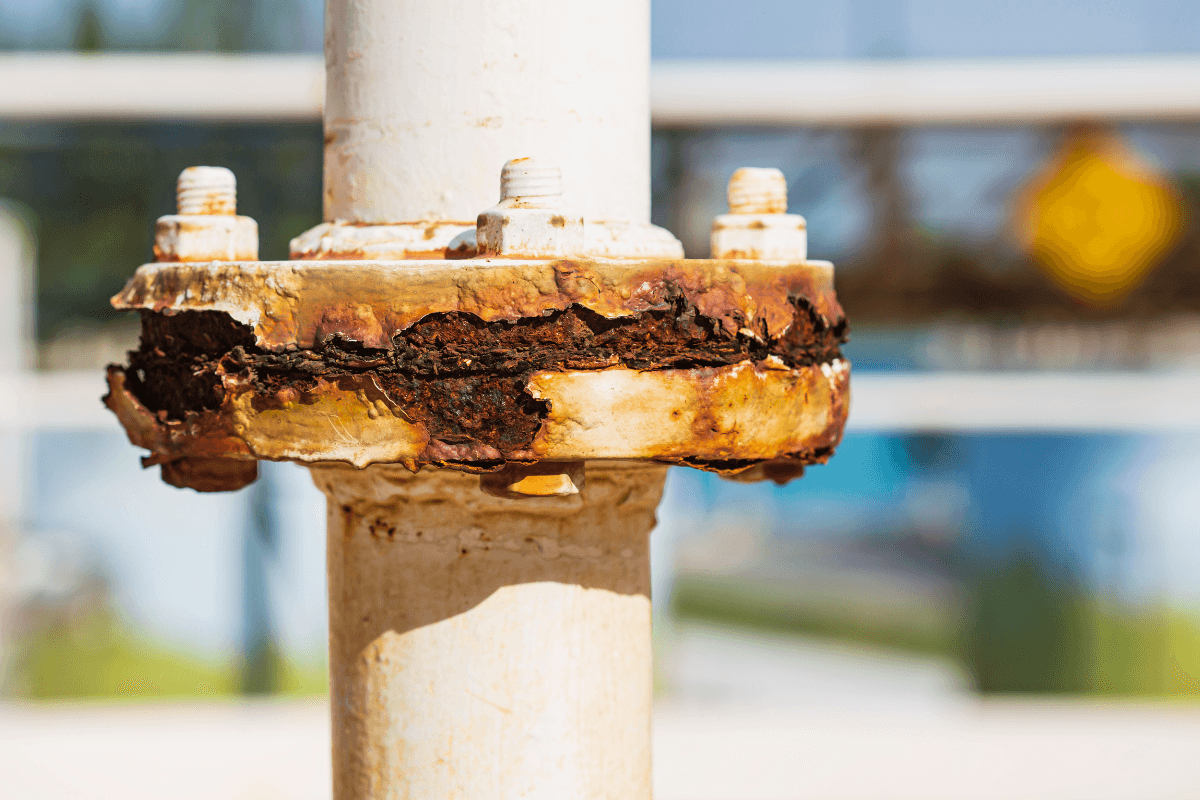
Hydrogen sulfide corrosion can turn a wastewater odour issue into a maintenance, rehabilitation, and asset-life problem. For municipalities, the hidden cost may include recurring repairs, premature equipment replacement, structural rehabilitation and emergency operating measures — not just odour complaints.
The challenge is that these costs rarely appear under one budget line. They accumulate across operations, maintenance, engineering and capital planning. A pump station may continue operating while H₂S exposure quietly shortens the life of concrete, coatings, electrical components and mechanical equipment.
By the time the damage becomes obvious, the municipality may be facing a much larger project than the original odour-control problem suggested.
Hydrogen Sulfide Corrosion Is More Than an Odour Problem
Hydrogen sulfide, or H₂S, is commonly recognized by its rotten-egg odour. In wastewater systems, however, odour is only one consequence of sulphide generation.
H₂S commonly develops when wastewater becomes oxygen-depleted. This can occur in long force mains, low-velocity gravity sewers, pump-station wet wells, tanks, and other locations where wastewater remains stagnant or has a long detention time. When wastewater becomes turbulent, such as at a force-main discharge or a wet-well inlet, dissolved H₂S can be released into the air.
Hydrogen sulfide is recognized as both an odour and corrosion concern in wastewater collection and treatment systems. Technical guidance from the U.S. Environmental Protection Agency identifies H₂S-related deterioration in concrete, metal pipe, tanks, mechanical equipment, electrical controls and instrumentation.
Canadian wastewater organizations and municipalities have identified similar risks, including premature sewer deterioration and the need for corrosion-control and monitoring strategies.
The financial consequences may include:
- More frequent inspections and maintenance.
- Premature coating or lining failure.
- Replacement of electrical and instrumentation components.
- Concrete patching and structural rehabilitation.
- Reduced service life of pipes, wet wells and tanks.
- Emergency bypass pumping or temporary treatment.
- Shutdown planning, excavation and traffic control.
- Additional engineering, contractor and operator time.
This is why hydrogen sulfide corrosion should be evaluated as an asset-management issue, and not only as an odour-control issue.
How H₂S Damages Wastewater Infrastructure
H₂S can damage infrastructure through more than one mechanism.
Concrete corrosion
In oxygen-depleted wastewater, microorganisms can reduce sulphate to dissolved sulphide. Depending on factors such as pH and temperature, some of that sulphide exists as dissolved H₂S.
When H₂S leaves the wastewater, it can accumulate in the air space above the liquid. On damp concrete surfaces above the waterline, H₂S can be oxidized, through biological and chemical pathways, to sulfuric acid. The acid attacks cementitious materials, weakening the concrete surface and exposing fresh material to further deterioration.
The most vulnerable areas may include:
- Sewer crowns and maintenance holes
- Wet wells and pump stations
- Headworks channels
- Tanks and other enclosed structures
- Force-main discharge points
- Sludge handling and dewatering areas
Under aggressive conditions, documented concrete loss can reach several millimetres per year. That is not a universal field rate, however. Actual deterioration depends on gas-phase H₂S exposure, humidity, temperature, wastewater chemistry, detention time, turbulence, concrete composition and ventilation. Research also shows that rapid concrete corrosion can occur through chemical as well as biological pathways under certain high-H₂S conditions.
Metal and equipment corrosion
H₂S-containing, humid atmospheres can also contribute to the deterioration of metals such as iron, steel and copper. Electrical contacts, controls, instrumentation and mechanical equipment may be vulnerable even when the concrete structure still appears serviceable. Although no material is completely corrosion-proof, using corrosion-resistant equipment can help reduce damage.
Copper contacts are particularly important because corrosion products can reduce electrical conductivity and contribute to unreliable controls.
Other exposed components may include:
- Switches, relays
- Sensors and instrumentation
- Ventilation equipment
- Metal supports, ladders and platforms
- Pumps, valves and other mechanical equipment
- Gratings, fasteners and structural components
This creates a common maintenance challenge: the facility may not yet have visible structural damage, but H₂S exposure may already be increasing equipment failures and repair frequency.
Atmospheric & Liquid-Phase Corrosion Require Different Solutions
A facility may have H₂S problems in the wastewater, in the air, or in both. Identifying where the problem occurs is essential because atmospheric and liquid-phase controls address different parts of the process.
Atmospheric H₂S exposure
Atmospheric exposure begins after H₂S leaves the wastewater and accumulates in a wet well, pump station, tank, sewer headspace, headworks area or other enclosed space.
This atmosphere can expose concrete, metals, electrical contacts, instrumentation and mechanical equipment to corrosive conditions. It can also create odour and worker-safety concerns.
Foul-air treatment technologies such as photoionization address this part of the problem by treating contaminated air after H₂S has been released. NeutraTek’s Neutralox technology uses UV light and catalysts to oxidize airborne contaminants and odours. Using corrosion resistant steel, the units durability is much stronger against H2S exposure as long as it is maintained properly and operated within design limits.
An independent test at the Gimli Wastewater Treatment Plant in Manitoba reported inlet H₂S concentrations averaging 54 ppm and peaking at 184 ppm during the first four-day test period, while outlet H₂S was reported as non-detectable. These results should be reviewed alongside the complete test report, including the airflow conditions, sampling method and detection limit.
Ventilation can dilute concentrations and support safer working conditions, but it does not destroy H₂S. If exhaust air is discharged untreated, a facility may shift an indoor exposure problem into an outdoor odour or compliance problem.
Liquid-phase sulphide
Sulphide can also build up within the wastewater itself, particularly in long force mains and other areas where wastewater remains in the system for extended periods.
Treating the air at the discharge point addresses H₂S after it has been released. It does not stop sulphide from forming upstream inside the force main or wet well.
Liquid-phase control may involve:
- Chemical dosing
- Hydraulic or process changes
- Improved wet-well operation
- Reduced detention time
- Sulphide oxidation or binding
- Other methods that act directly in the wastewater
Photoionization works on the air side of the problem. Facilities dealing with both liquid-phase sulphide and atmospheric H₂S may therefore require a layered strategy rather than a single control method.
What Photoionization Can and Cannot Do
| Photoionization can help with | Photoionization does not, by itself |
|---|---|
| Treating airborne H₂S in enclosed foul-air spaces | Stop sulphide from forming inside a force main |
| Reducing atmospheric H₂S concentrations | Correct anaerobic conditions upstream |
| Reducing odour after H₂S has entered the air | Remove existing concrete damage |
| Reducing exposure of above-waterline concrete and equipment | Replace structural rehabilitation |
| Supporting an atmospheric corrosion-risk reduction strategy | Eliminate the need for liquid-phase control where that is required |
This distinction is important when evaluating potential solutions. The appropriate question is not simply, “Which odour-control technology should we install?” It’s, “Where is sulphide being generated, where is H₂S being released, and which assets are being exposed?”
How H₂S Grows Over Time
Hydrogen sulfide corrosion does not follow one fixed timeline. The financial impact generally grows as deterioration progresses.
Early costs may appear as:
- Inspections and H₂S monitoring
- Coating repairs
- Concrete patching
- Electrical troubleshooting
- Replacement instrumentation
- Mechanical component repairs
- Recurring contractor callouts
As damage progresses, a facility may require:
- More substantial concrete rehabilitation
- New protective linings
- Replacement of exposed equipment
- Pipe rehabilitation or replacement
- Structural engineering
- More frequent shutdowns or bypass operations
If structural integrity is affected, the work may expand further. Excavation, bypass pumping, temporary treatment, traffic control, contractor mobilization, environmental response and emergency procurement can all become part of the project.
The municipality is then paying for two related problems:
- Repairing or replacing the damaged asset
- Keeping the wastewater system operating while the repair is completed
Identify the Hidden Cost At Your Facility
A useful estimate starts with expenses already appearing in maintenance and capital budgets. Review at least the previous three to five years, then separate costs that are directly or plausibly associated with persistent H₂S exposure.
1. Reactive maintenance
Include corrosion-related:
-
- Labour
- Coating repairs
- Concrete patching
- Electrical repairs
- Replacement components
- Instrumentation failures
- Mechanical repairs
- Recurring contractor work
2. Annualized capital renewal
If a known rehabilitation project is expected to cost $750,000 and is expected to recur every 15 years, a simple planning estimate would be:
$750,000 ÷ 15 = $50,000 per year
A municipality may instead use a more detailed annual-equivalent calculation that accounts for timing, financing and discount rates.
3. Premature asset-life cost
Compare the expected service life of the asset with its current condition.
For example, if a structure was expected to last 50 years but requires major rehabilitation after 20 years, the municipality has lost 30 years of planned service. That shortened life should be reflected in the asset-management and lifecycle-cost analysis.
4. Monitoring and labour
Include:
-
- H₂S monitoring
- Confined-space preparation
- Inspections
- Troubleshooting
- Additional cleaning
- Operator time
- Engineering assessments
- Reporting and compliance work
5. Expected failure cost
Estimate the probability of a failure and multiply it by the total consequence cost:
Expected failure cost = Probability of failure × Total consequence cost
The consequence cost may include:
-
- Emergency repair
- Bypass pumping
- Temporary treatment
- Excavation
- Traffic control
- Contractor mobilization
- Engineering and permitting
- Overtime
- Environmental response
- Service disruption
You will not get a perfect number. The objective is to create a more complete estimate of what H₂S is already costing across operations, maintenance and capital planning.
Illustrative Example
A single major rehabilitation project can cost thousands once structural repair, bypass pumping, excavation, traffic management, engineering, temporary treatment and emergency procurement are included. The actual amount varies significantly by asset, location and project scope, so municipalities should use local project estimates rather than assume a universal industry figure.
The key point is that preventing or reducing atmospheric H₂S exposure should be evaluated against the full cost of recurring maintenance, shortened asset life and potential failure, not only against the cost of responding to odour complaints.
Hydrogen Sulfide Corrosion Control Often Requires a Layered Approach
H₂S can develop in more than one part of a wastewater system. Corrosion control may therefore involve several complementary measures.
In the liquid phase, chemical dosing or process changes may help suppress sulphide formation, oxidize sulphides or bind them before H₂S is released.
Where infrastructure is already exposed to corrosive conditions, protective linings and corrosion-resistant materials can help protect concrete and other vulnerable surfaces. These measures are especially relevant during rehabilitation and new construction.
Once H₂S has entered the air, atmospheric treatment becomes relevant. Photoionization may help treat contaminated foul air and reduce atmospheric H₂S exposure in enclosed spaces.
For many facilities, the most effective strategy combines measures so that each one addresses the part of the problem it is designed to handle:
- Liquid-phase controls address sulphide formation or dissolved sulphide.
- Protective materials address vulnerable infrastructure.
- Atmospheric treatment addresses H₂S after it enters the air.
- Monitoring verifies conditions and helps guide operating decisions.
Assess Your Facility’s H₂S Risk
A corrosion-risk review can begin with the following questions:
- Where are H₂S concentrations highest?
- How much do concentrations fluctuate throughout the day and across seasons?
- Where is H₂S most likely to be released?
- Are the highest-risk locations force-main discharges, wet wells, headworks, tanks or other enclosed spaces?
- Which concrete, metal, electrical and mechanical components are exposed?
- Are coatings, controls or equipment failing earlier than expected?
- How much has the facility spent on corrosion-related maintenance during the past several years?
- Is the problem occurring in the liquid phase, the air phase or both?
- Are there planned rehabilitation projects that may be related to H₂S exposure?
- What would a failure cost to manage under emergency conditions?
These answers can help determine where deterioration is occurring, which costs should be included in the business case and whether the facility needs liquid-phase controls, atmospheric treatment, protective materials or a combination of approaches.
At many pump stations, corrosion-risk reduction is one reason odour-control systems are installed in the first place. Reducing atmospheric H₂S exposure can help protect vulnerable infrastructure while also addressing nuisance odours.
Talk to NeutraTek About H₂S Corrosion Control
If H₂S is already appearing in maintenance records, deteriorating coatings, concrete damage or recurring equipment failures, it is worth putting a number to those costs before the next major repair reaches the capital budget.
NeutraTek can help assess the foul-air side of your H₂S problem and determine where photoionization may fit within a broader odour and corrosion-risk reduction strategy.
Contact our team today or find a representative in your area.