Table of Contents
- Environmental Control Technology for Wastewater
- Biological Filtration (Biofilters)
- Chemical Scrubbers (Wet Scrubbers)
- Activated Carbon Filters
- Photoionization
- Regulatory Requirements in Canada
- How to Choose the Right Odour Control Technology
- Environmental Control Technology Comparison
- FAQs about Odour Control Technology
Choosing an odour control system for municipal wastewater encompasses at least four variables. Total install cost, consumables cost, operational costs and ongoing maintenance. Most technologies can’t optimize for all of these. The best decision is reached by undertaking a complete life-cycle cost analysis.
Whether you’re managing a wastewater treatment plant in British Columbia or designing a lift station in Ontario, the challenges are unique, yet similar: eliminate odour complaints and stay within budget. Choose wrong, and you’ll deal with persistent odour complaints, regulatory violations, and maintenance costs that exceed your budget.
Environmental control technology for wastewater treatment includes several approaches: biological filtration, chemical scrubbers, activated carbon, and photoionization. Each has different total installed cost, removal efficiency, operational cost, and maintenance requirements. Here’s how they compare.
Environmental Control Technology for Wastewater
In the context of wastewater and industrial processing, environmental odour control technologies are engineered systems designed to remove contaminants from foul air streams. Specifically, odour-causing compounds like hydrogen sulphide (H₂S), mercaptans, ammonia (NH₃) and volatile organic compounds (VOCs).
These systems capture or neutralize pollutants before they’re released, rather than simply venting contaminated air to the atmosphere.
Leading Odour Control Technologies
Biological Filtration (Biofilters)
Biofilters use beds of organic media (like wood chips, compost, or engineered synthetic alternatives) to host bacterial colonies that break down odour-causing compounds as contaminated air passes through.
The primary advantage is lower capital equipment cost compared to other technologies. Biofilters handle a wide range of water-soluble odours effectively, with removal efficiencies reaching 95-99% for compounds like H₂S under optimal conditions like stable and low H₂S levels.
Trade-offs are footprint, total installed cost, and maintenance. Biofilter beds require significant space, and the media degrades over time, causing compaction and increased pressure losses. Media replacement is periodic but labour-intensive.
Cold weather creates additional challenges. Bacterial activity drops in freezing temperatures, which means facilities in Canadian climates need insulation or heating to maintain performance through winter. Biofilters work best at larger facilities with available land, steady airflows, and moderate contaminant concentrations.
Chemical Scrubbers (Wet Scrubbers)
Chemical scrubbers treat contaminated air by passing it through a chamber where liquid chemical solutions, typically sodium hydroxide (caustic soda) or sodium hypochlorite (bleach), react with and neutralize target gases like H₂S. The chemical reaction converts hydrogen sulfide into non-odorous compounds that remain in the liquid phase.
The advantage is a compact footprint and high removal efficiency. Scrubbers can achieve >95% H₂S removal in tight spaces, making them viable for retrofit applications or sites with limited real estate.
The trade-off is operational cost and complexity. As well, chemical scrubbers target specific odour constituents like H₂S but do not tackle all contaminants in a foul air stream.
Chemical scrubbers require a continuous chemical supply, storage infrastructure, and trained staff to handle caustic materials safely. The process also generates a spent chemical waste stream that requires treatment or disposal. Chemical scrubbers work best at high-flow, high-concentration industrial sites where chemical handling systems are already in place.
Activated Carbon Filters
Activated carbon filters pass contaminated air through beds of carbon media that adsorb odour compounds onto their porous internal structure. The systems have few moving parts, which simplifies operation and maintenance.
Carbon filters work well for low-concentration applications or as a polishing step after primary treatment (i.e. biofilter). Removal efficiency for low-level H₂S and VOCs typically ranges from 90 to 95% when the media is fresh.
The limitations are media lifespan and inability to handle relative humidity greater than 70%. High H₂S loads exhaust carbon beds quickly, requiring frequent replacement. Media costs are variable depending on contaminant concentration, and replacement intervals can be difficult to predict.
Saturated carbon also presents a fire hazard due to heat generation from adsorbed compounds. Activated carbon fits best at small lift stations with low contaminant loads or as secondary treatment downstream of biofilters or chemical scrubbers, noting that a dehumidification step must be added between these two stages.
Photoionization
Photoionization processes, including Neutralox Photoionization (PI), use ultra-violet (UV) light reactions to oxidize odour molecules at the molecular level. PI systems generate highly reactive oxygen species, which oxidize hydrogen sulphide and other odour compounds on contact into neutral byproducts. Neutralox PI adds an additional treatment phase utilizing a carbon based catalyst to provide a surface area for both oxidants and contaminants to continue an exothermic adsorption process which acts as a buffer or polisher.
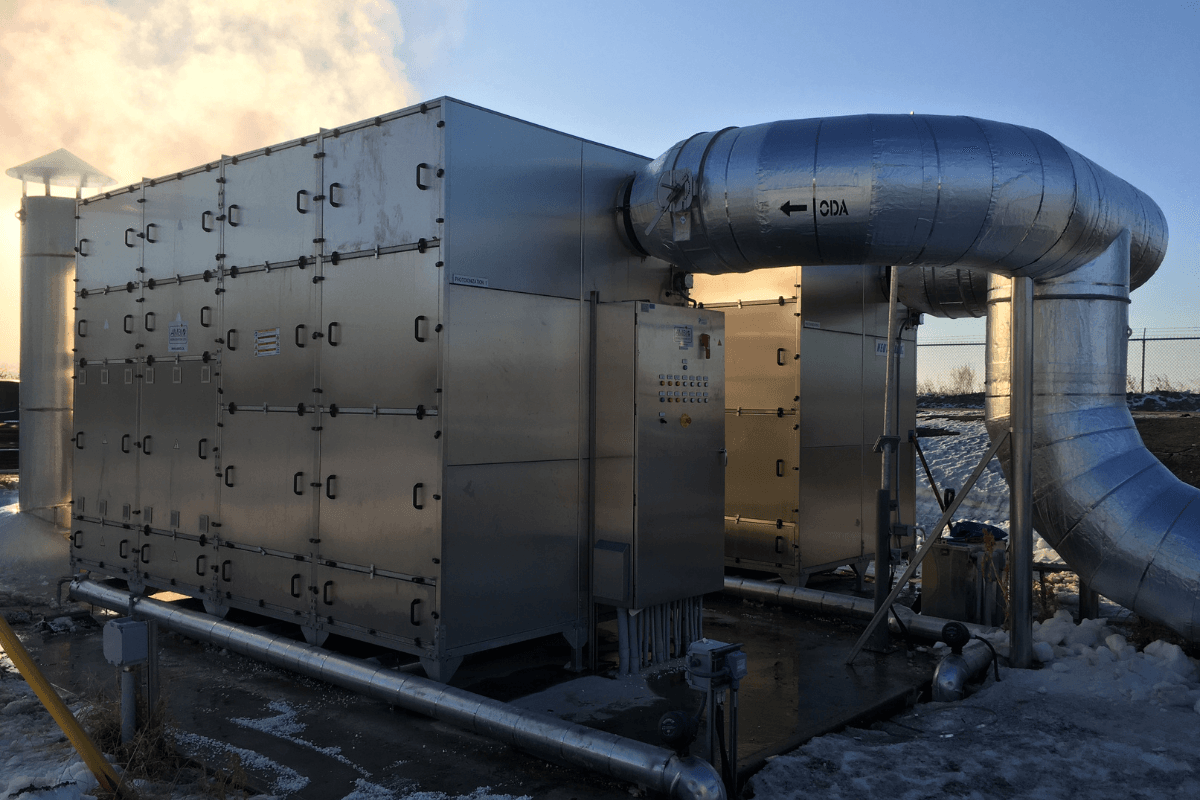
Photoionization odour control installation at Gimli, Manitoba wastewater treatment facility.
PI systems achieve H₂S removal efficiency exceeding 99% and handle fluctuating contaminant loads without performance degradation. Oxidation doesn’t discriminate — PI does not target specific contaminants but oxidizes all foul air constituents. The systems require minimal maintenance since there are no chemicals, water, or biological media to manage. The compact footprint fits retrofit applications where space is limited.
Capital equipment costs are higher than biological or carbon systems but total installed costs are competitive. However, low consumable replacement cost, operational cost (power), and low maintenance requirements reduce overall operating expenses over the system’s lifespan. Total cost of ownership favours PI at facilities with limited maintenance staff, high H₂S concentrations, or space constraints.
Photoionization favours facilities in residential areas where odour complaints are present, sites have a limited footprint, or operations have minimal maintenance resources. Contact your regional representative to evaluate whether PI technology aligns with your facility’s airflow and contaminant profile.
Regulatory Requirements in Canada
Provincial emissions standards in Canada continue to tighten. Ontario’s air quality regulations set specific limits on H₂S and VOC releases, while British Columbia requires environmental impact assessments for new installations and facility expansions. The Canadian Council of Ministers of the Environment provides guidance on ambient air quality objectives that influence local enforcement.
Federal standards set baseline requirements, but municipal bylaws often impose stricter limits on nuisance odours. Facilities near residential areas face particular scrutiny. Regulators require documented removal efficiency data, which means systems that rely on dilution or masking compounds won’t meet compliance standards.
When evaluating odour control technologies, verify that the system can achieve continuous treatment and meet your jurisdiction’s specific emission limits. Provincial regulations vary, so consult local environmental authorities during the planning phase.
How to Choose the Right Odour Control Technology
Each technology has different total installed costs, annualized consumable costs, operating and maintenance expenses, and performance characteristics. The right option depends on your facility’s specific constraints and a complete life-cycle cost analysis of all technologies.
Airflow and Contaminant Profile
Steady, low-concentration odours suit biological filtration or activated carbon. High H₂S concentrations or fluctuating loads require chemical scrubbers or photoionization. Biological and carbon systems can’t respond quickly to spikes; photoionization adjusts in real time.
Total Cost of Ownership
Total installed cost is only part of the equation. Factor in energy cost, chemical purchases, media replacement intervals, water consumption, and operator labour over 20-30 years. A chemical scrubber with a lower upfront cost may require three times the operating budget of a photoionization system over its lifespan.
Maintenance Resources
Consider your team’s skill sets and capacity. Biofilters require frequent media maintenance to maintain biology. Chemical scrubbers need trained staff for handling caustic materials. Activated carbon demands regular media replacement. Photoionization systems run with minimal intervention. Match the technology to your available labour and expertise.
Physical Footprint
Biofilters require significant land area. Chemical scrubbers and photoionization systems fit tighter spaces, making them viable for urban retrofits or facilities with limited real estate.
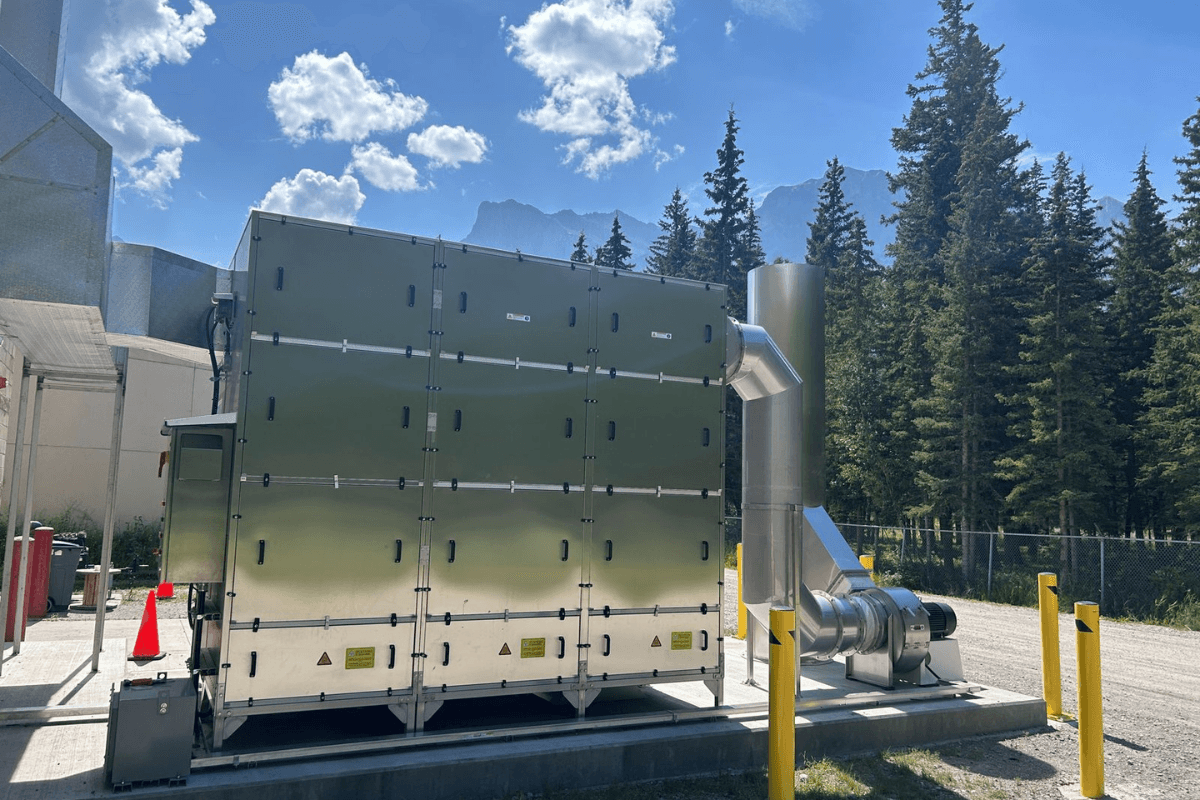
For real-world examples of how facilities matched technology to their constraints, see our Canmore, AB, Medellin, CO, and Gimli, MB installations.
Environmental Control Technology Comparison
The table below compares removal efficiency, maintenance requirements, and ideal applications for each technology.
| Technology | H₂S Removal | Maintenance | Best For |
|---|---|---|---|
| Biological Filtration | 95-99% | Medium (media replacement) | Large sites, steady loads |
| Chemical Scrubbers | >95% | High (chemical handling) | High concentrations, existing infrastructure |
| Activated Carbon | 90-95% | Medium (frequent replacement) | Low loads, polishing |
| Photoionization (PI) | >99% | Low (minimal intervention) | High concentrations, space-constrained, minimal staff |
Selecting the Right System
Choosing an odour control technology comes down to balancing infrastructure protection, regulatory compliance, and community relations against your facility’s CAPEX and OPEX budgets.
Biological filtration works for facilities with available land, steady contaminant loads, and lower capital budgets. Chemical scrubbers handle high H₂S concentrations at sites with existing chemical handling infrastructure. Photoionization delivers >99% removal efficiency in compact installations with minimal ongoing maintenance.
Base your decision on verified performance data, total cost of ownership projections, and your facility’s operational constraints. Request a technical assessment or contact your regional representative for a site-specific evaluation.
Frequently Asked Questions
Advanced oxidation (photoionization) delivers the highest H₂S removal efficiency at >99%, while biological filtration and chemical scrubbers typically achieve 95-99% removal. The most effective technology depends on your facility’s space constraints, maintenance resources, and contaminant loads.
Four primary technologies remove H₂S from wastewater foul air: biological filtration uses bacteria to break down compounds, chemical scrubbers neutralize gases with caustic solutions, activated carbon adsorbs odours onto porous media, and photoionization uses UV light and a catalyst to create reactive oxygen species that oxidize H₂S on contact.
Chemical scrubbers and photoionization systems perform consistently in freezing temperatures. Biological filtration requires insulation or heating to maintain bacterial activity during Canadian winters, which increases operating costs and complexity.
Yes. Provincial regulations and municipal bylaws in Canada typically require permits for odour control installations. Requirements vary by jurisdiction, so consult your regional environmental authority during the planning phase.