Odour control challenges are present at every facility dealing with foul air streams, often resulting in complaints from neighbouring communities.
Managing municipal and industrial odours can be difficult, and most traditional methods for odour control only target specific constituents. Think as if you are putting a bandage on a broken leg. Frequent approaches include masking odours with chemicals or utilizing carbon filters that require frequent replacement.
There’s a process that addresses all odour challenges directly and efficiently. That solution is photoionization (PI) technology.
It is critical to understand the process before making a decision for your situation, whether you are an engineer or facility manager.
What is Photoionization for Odour Control?
Photoionization sounds complex, but the principle is straightforward: an oxidation process that removes contaminants from foul air streams using UV light to oxidize foul odour molecules.
It is the process of using photons (light particles) to interact with atoms or molecules. When a high-energy photon hits a molecule, it knocks an electron out of its orbit. This turns a stable, neutral molecule into a charged ion. This is what creates the oxidants OH-, O3 etc.
Most foul-smelling compounds, such as volatile organic compounds (VOCs), hydrogen sulphide (H₂S), ammonia, and mercaptans, are all odour molecules stable enough to travel through the air and cause issues, but they’re chemically vulnerable.
When we use photoionization for odour control, we expose these airborne contaminants to high-energy ultraviolet (UV) light. We use specific wavelengths that have sufficient energy to break chemical bonds.
Here’s what happens in the UV reactor:
- Excitation: The UV light hits oxygen molecules in the air stream.
- Dissociation: The energy splits the oxygen molecules into individual oxygen atoms.
- Ozone Formation: Some of these single atoms grab onto other O₂ molecules to form ozone.
- Radical Creation: Simultaneously, the UV light creates hydroxyl radicals and other highly reactive oxygen species.
- Oxidation: These radicals and the ozone attack the odour molecules (the VOCs, H₂S, NH₃, DMS, mercaptans, and others). They steal electrons, break carbon-hydrogen bonds, and essentially disassemble the pollutant.
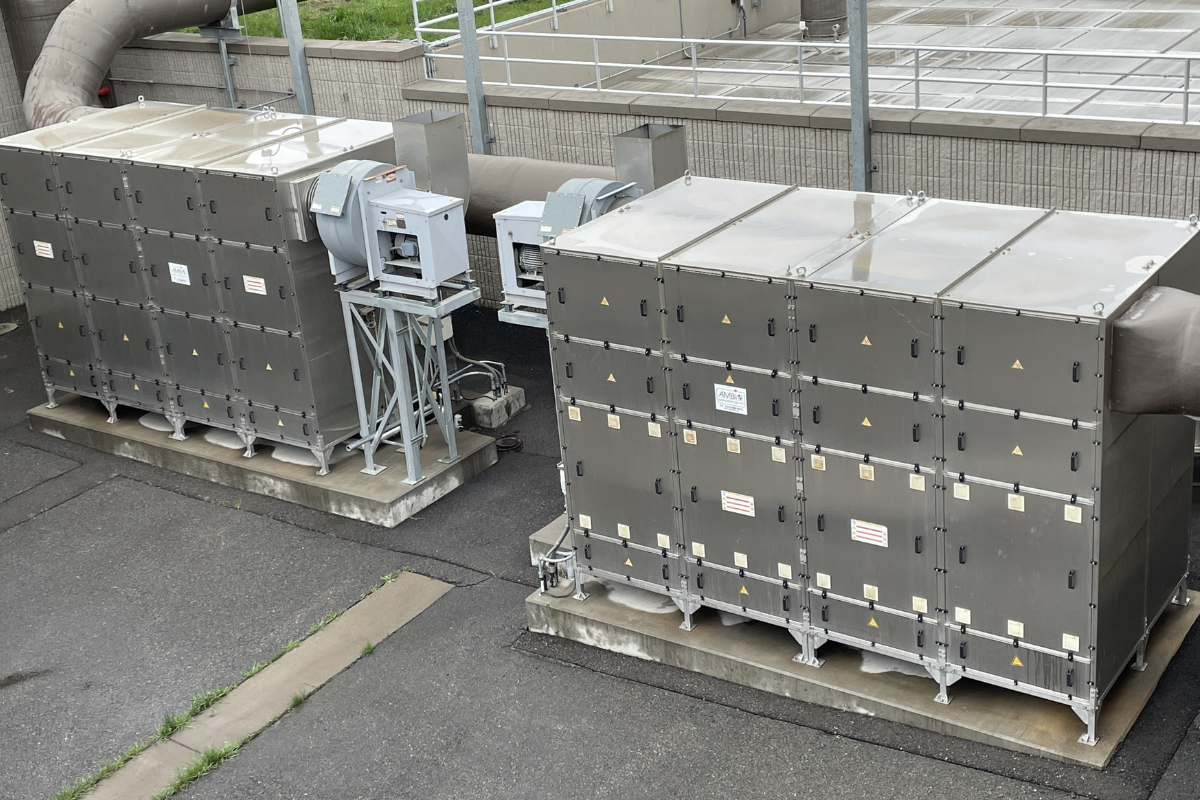
This is the main process principle behind Neutralox PI units.
Photoionization’s Edge Over Scrubbers and Carbon
First, traditional chemical scrubbers rely on mass transfer: you must force contaminated air through a liquid medium containing chemicals specific to the constituent to remove odours and pollutants.
This means buying chemicals, storing chemicals, and disposing of spent chemicals – a costly, labour-intensive process with ongoing safety and environmental compliance requirements.
Carbon filters are passive, acting like a sponge – and like sponges, they get full. Once activated carbon sites saturate with pollutants, the filter stops working or, worse, begins re-releasing odour through desorption. You’re left monitoring breakthrough points and paying for multiple and expensive media change-outs.
Photoionization is different because it’s a form of removal and polishing. Rather than storing the smell in a filter media to deal with later, you’re destroying the molecule instantly during treatment.
A study published in Nature reported that advanced oxidation processes like photoionization are highly effective at reducing VOCs, with removal rates influenced by airflow and concentration. That represents massive efficiency without a single drop of bleach. So how does a Neutralox PI unit achieve these results?
The Anatomy of a Neutralox PI Unit
Neutralox PI units consist of two primary components working in sequence:
UV Bank
Ultraviolet light breaks up odorous compounds at the molecular level. In the process, two powerful oxidizing agents form: ozone and hydroxyl radicals. These reaction partners have a strong oxidizing effect, removing odours as air passes through the chamber.
Catalyst
The catalyst absorbs residual substances and fragments from the UV reactor, acting like a polishing stage. Ozone (O₃) and hydroxyl radicals then break down these remaining compounds even further, ensuring near-complete purification before air exits the system.
The result? Clean air that no longer smells.
Watch how Neutralox PI units eliminate odours through photoionization.
Where Else Does This Work Besides Wastewater?
While wastewater treatment plants are the classic use case for photoionization (after all, nobody likes the smell of lift stations), photoionization is incredibly versatile and can handle a wide spectrum of organic odours. From pump stations and waste storage facilities to industrial manufacturing, it’s a strong contender for industries you might not expect.
Food and Beverage Processing
If you’ve ever driven past a coffee roaster, you know the smell is appealing at first but quickly becomes overwhelming. Dairy plants also cause unpleasant odourous compounds. Organic odours are potent at these kinds of facilities, but photoionization can help. It breaks down the aldehydes and ketones responsible for these strong food smells without using chemicals that could contaminate the product.
Rendering and Meat Processing
The breakdown of animal byproducts releases complex amines and fatty acids, which are some of the most complaint-generating smells in existence. Photoionization attacks the biological structure of these airborne compounds, neutralizing them before they exit the stack.
Making the Case for Photoionization
If you’re pitching Neutralox PI units to your CFO or operations team, they likely won’t care about hydroxyl radicals or molecular bond dissociation.
What they will care about is operational expenditure, total installed costs, and whether this technology delivers on its promises. Here’s where Neutralox wins:
Low Maintenance: UV bulbs require replacement every 12,000 hours of operation. No weekly chemical deliveries. The catalyst is changed based on design loading. The system runs with minimal intervention, freeing up your maintenance team for other priorities, as only one to two people are required for a consumables changeout.
Energy Efficiency: Pressure drops across a Neutralox unit are negligible compared to pushing air through dense carbon beds or wet scrubber towers. Your fans work less, saving electricity and reducing wear on equipment.
Scalability: Need to handle more air? Neutralox PI systems can handle high loads of foul air streams and can be customized to your facility’s needs.
Plug-and-Play Implementation: Neutralox PI units arrive preassembled with the ancillary equipment easy to connect and ready for installation. All you need is a concrete foundation and a power connection. This means faster deployment and less disruption to operations.
Proven Performance: From hot climates to the cold of Northern Canada, Neutralox systems operate reliably in diverse conditions, meeting the demands of facilities.
Engineer a Cleaner, Fresher Future
If your facility is dealing with foul air streams – and you’re tired of the logistical nightmare of other odour systems – Neutralox PI units will perform.
It’s clean. It’s scientifically sound. It’s elegant engineering.
When you shift from passive capturing to odour elimination, you take control of your emissions.
Stop apologizing for the odours and start solving the problem at the molecular level. Explore Neutralox PI units for odour control you can count on.